April is internationally recognized as Genocide Awareness Month, as the month encompasses several key commemorative dates for several genocides, most notably the Holocaust, the Rwandan Genocide, and the Armenian Genocide:
Taken together, these commemorations call not only for remembrance, but they create an opportunity for educational efforts that consider the conditions under which such violence emerges.
During the month of April, the Zoryan Institute is launching a month-long series titled “Ottoman Multiculturalism” Through the Armenian Experience: A Case for Understanding the Multicultural Strength and Institutional Fragility of the Ottoman Empire. What this project will refer to as “Ottoman Multiculturalism” is a system of non-territorial autonomy that organized diverse religious communities into separate, self-governing units under their own laws and leaders, while ensuring overall imperial control. However, it should be noted that the distinct difference between “Ottoman Multiculturalism” and modern multiculturalism is that the former was based on group rights, not individual rights, as we are accustomed to and was based on a hierarchical, non-equitable structure that placed Muslims at the top. Through this initiative, the Institute is taking a closer look at the historical dynamics of multicultural governance, using the Ottoman Empire as a laboratory for understanding both the promise and the fragility of plural societies.
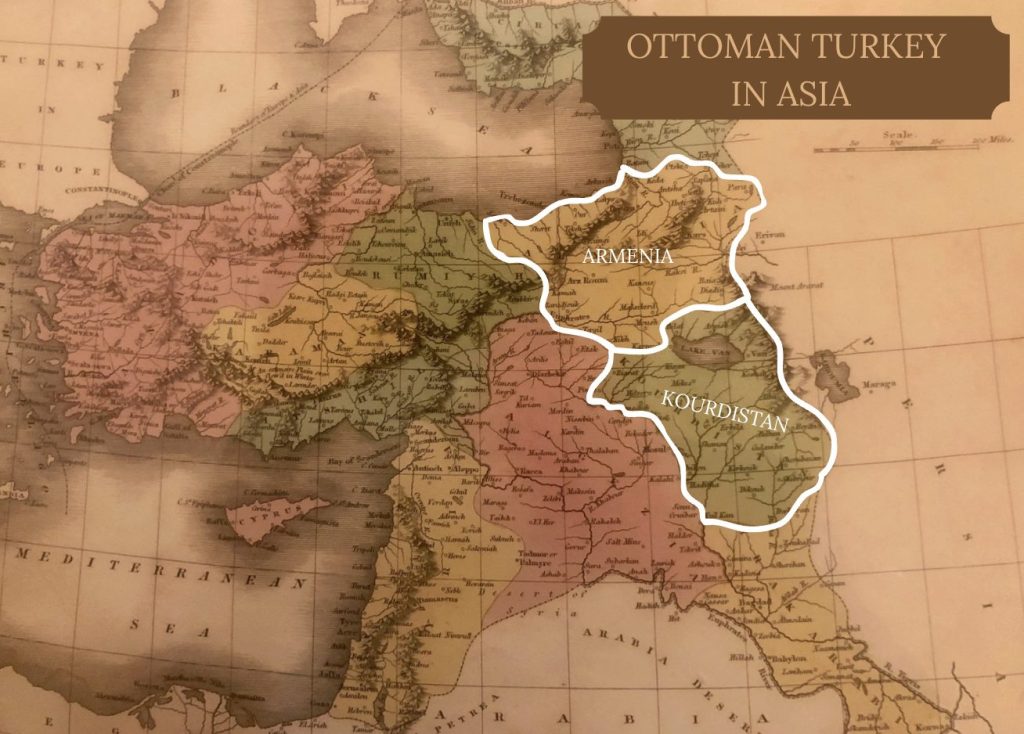
Map of Ottoman Turkey in Asia (as seen in Collective and State Violence in Turkey by Stephan Astourian and Raymond Kévorkian)
The central purpose of this work is educational: to help Armenian and Turkish youth better understand a shared past in which their communities lived as close neighbours, cultural, and economic partners with other religious and ethnic groups before erupting into hostility toward one another. Ultimately, the series seeks to reduce stereotypes and recrimination between Armenians and Turks, address “us versus them” mentalities, and in the process, hopefully encourage reflection on how the youth of these two diverse societies can forge a peaceful future of coexistence as neighbouring nations.
It is important to note that this initiative is not an attempt to minimize the genocidal acts of 1915, otherwise known as Medz Yeghern, carried out by the Ottoman authorities, nor does it absolve Turkish authorities from the ongoing responsibility of acknowledging these crimes. By presenting snapshots of historical events, institutions, and cultural life during the Ottoman empire, the project encourages young Armenian and Turkish readers to reflect on their shared history, identify structural lessons from the past, and reflect on how trust, equity, and coexistence might be strengthened between their respective countries as neighbouring societies today.
Day 2: The Millet System
Released April 2, 2026.
This installment examines the Ottoman millet system and how it enabled diverse religious communities—like Armenians, Greeks, and Jews—to maintain autonomy, while also revealing the system’s limits and inequalities.
Day 3: Administration in the Millet System
This installment examines how Armenians managed internal affairs under the Ottoman Millet System, with the Patriarch balancing community autonomy and Ottoman state control. It highlights key areas like taxation, education, and legal authority, showing how limited self-governance shaped their daily life and contributed to historical challenges.
Day 4: Armenian Cultural Renaissance
This installment looks at the Armenian cultural renaissance, or “Zartonk,” under the Ottoman millet system and how it shaped community life. Centered in Istanbul, Armenians built schools, print culture, and literary traditions that helped strengthen identity and ideas. Even without political power, this period shows how much cultural and intellectual life could grow within imperial limits.
Day 5: Economic Life in the Ottoman Empire Through the Millet System
This installment looks at economic life under the Ottoman millet system and how different communities contributed to a shared economy. Armenians, Greeks, and Jews developed specialized roles in fields like trade, finance, and craftsmanship, creating strong connections across society. While inequality remained, this system shows how cooperation and interdependence helped sustain the empire.
Day 6: The Unravelling of Ottoman Multiculturalism
This section traces how the Ottoman Empire’s long-standing system of managing diversity gradually gave way to exclusion and violence. By the early 20th century, war, state policies, and mass violence, including pogroms, forced deportations, and genocidal campaigns such as the Armenian Genocide, had transformed Anatolia from a diverse society into one where non-Muslim populations were nearly erased.