
Day 3: Administration in the Millet System
Today’s release will expand on the Millet System (see Day II) from the Armenian perspective.
For Armenians within the Ottoman millet system, communal life was defined by a careful balance between internal autonomy and imperial control. As a recognized religious community, the Armenians were organized under the authority of the Patriarch in Istanbul, who served as both a religious leader and the official intermediary with the Ottoman state. Armenians governed many aspects of their daily life, however they remained firmly subordinate to a centralized imperial authority in line with the Millet system’s religious hierarchy.
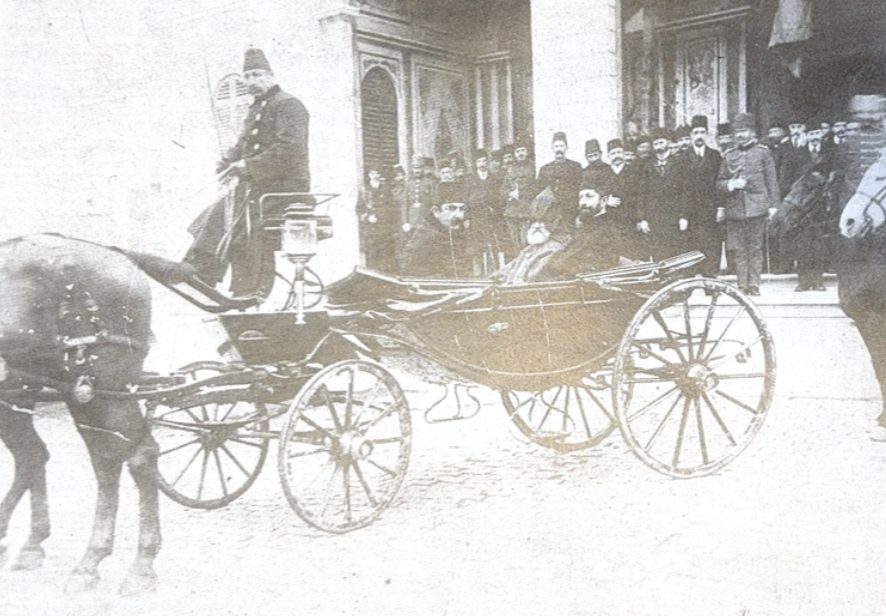
Departure of the Armenian Patriarch of Istanbul, Yeghishe Turyan, from Yıldız Palace after being received by the Ottoman Emperor (1909). Source: Western Armenians Throughout History Volume III – (1891 – 1922) by Dr. Pars Tuğlacı (2004)
Taxation: Armenians did not determine fiscal policy, but the Patriarch of Istanbul was responsible for organizing tax collection from the community. These included land taxes and occasional extraordinary levies, but the most prominent obligation was the jizya, a poll tax imposed on non-Muslim adult males as they were prohibited from participating in military service by the Ottoman state. The Patriarchate, working with local elites, assessed and distributed these burdens within the community and ensured their transfer to the Ottoman centre. This role granted Armenian leaders practical authority within their community but were made entirely accountable to Ottoman officials for their community’s affairs (please see image below demonstrating the power relationship between the Patriarch and Sultan).
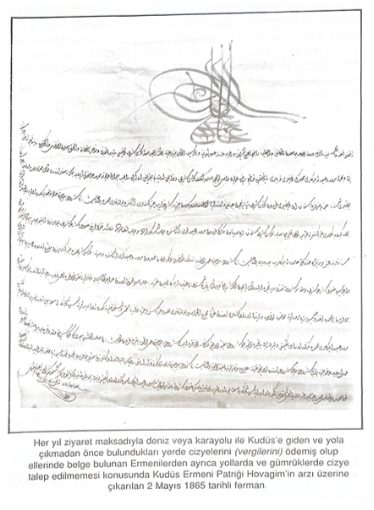
At the request of Armenian Patriarch Hovagim of Jerusalem, Armenians traveling to the city were granted relief from paying jizya along the way, though they still paid it in their home regions. Source: Western Armenians Throughout History Volume III – (1891 – 1922) by Dr. Pars Tuğlacı (2004).
Education formed another key sphere of communal control. Armenian schools, totalling around 1,900, were often attached to churches and monasteries, which totalled over 2,300, and were essential for preserving language, religion, and identity. Instruction emphasized liturgy, Armenian history, and literacy, while gradually incorporating more secular subjects by the nineteenth century. For much of this period, the Ottoman state imposed little direct control over curricula, allowing Armenians considerable freedom in education.
Institutional authority extended to churches, monasteries, and communal property. Armenian leaders appointed clergy, managed endowments, and regulated religious and social life. The Church exercised jurisdiction over family matters such as marriage, divorce, and inheritance through ecclesiastical courts. There was no single civil code governing personal status across the empire for religion; instead, each religious community followed its own civil legal traditions. Notwithstanding the above, criminal law and public order remained under Ottoman jurisdiction, and inter-communal disputes could be taken to state courts consistent with the same hierarchical structure of the millet system.
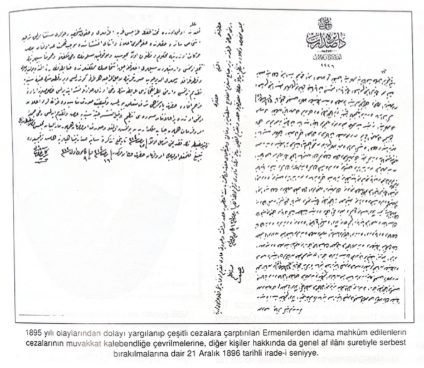
A decree dated 1895 concerning Armenians who were tried and sentenced to various punishments, including those sentenced to death, for the conversion of their sentences to temporary imprisonment; this was facilitated by the Armenian Patriarch with the Sultan. This is an example of how power was balanced between community leaders and the Ottoman state. Source: Western Armenians Throughout History Volume III – (1891 – 1922) by Dr. Pars Tuğlacı (2004).
While Armenians were in charge of their internal affairs, the Ottoman state could remove this designation of power and override their decisions unilaterally. Muslim citizens were governed directly through imperial and Islamic institutions, which still preserved the dominance of Muslim citizens over them, categorizing them as dhimmi.
“Millet-i Sadika” or “Loyal Community”: In 1853, the Armenian Patriarchate received recognition from the Ottoman state through imperial decrees granting privileges in acknowledgment of the community’s loyalty, emphasizing their status as loyal subjects, known as the “Millet-i Sadıka.” This highlights their recognized allegiance, peaceful coexistence, and lack of rebellion in contrast to other groups, despite later narratives portraying Armenians as disloyal.
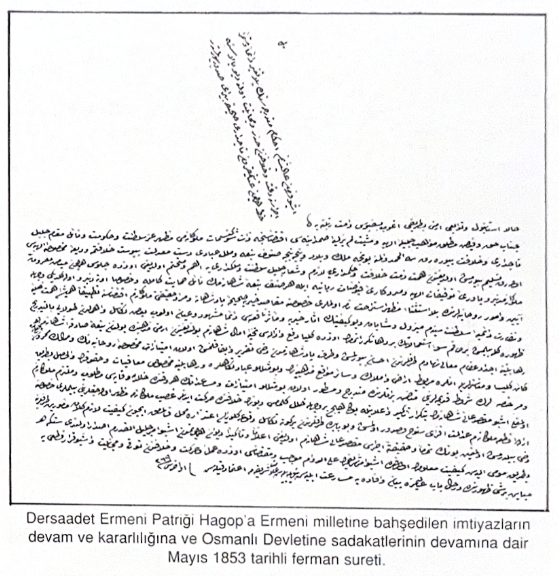
A copy of the May 1853 decree addressed to Patriarch Hagop of Constantinople, concerning the continuation and stability of the privileges granted to the Armenian nation and their continued loyalty to the Ottoman State. Source: Western Armenians Throughout History Volume III – (1891 – 1922) by Dr. Pars Tuğlacı (2004).
While Armenians were originally represented by a single Patriarch, by the 19th century, the community had been divided into separate millets. These included the Armenian Gregorian Millet and the Armenian Catholic Millet, which was officially recognized in 1831, followed by the recognition of Protestant Armenians as a separate millet by the 1850s under the influence of European and American missionaries.
This fragmentation of the Armenian millet weakened its already limited powers within the Ottoman state and contributed to their vulnerability to facilitate the forced deportation of Armenians during Medz Yeghern in 1915.
Stay tuned for our next installment, expanding on the Armenian cultural renaissance during the Ottoman Empire. To explore the full series, visit our main page here, where all releases will be collected for easy reading as they become available.