
Day 5: Economic Life in the Ottoman Empire Through the Millet System
Today’s release will build on previous discussions of the Millet system (see Day IV) to explore the expansion of economic activities of the Armenian and other minority communities during the Ottoman Empire.
Within the Ottoman millet system, economic viability was not simply a practical concern but a structural necessity that underpinned the functioning of the empire. From the vantage point of communities such as the Armenians, economic life developed through patterns of cooperation, specialization, and interdependence that linked different religious groups within a shared imperial framework. Although these occupational patterns were not formally imposed by the state, they emerged over time as communities adapted to opportunities, constraints, and networks within the Ottoman economy.
Armenians, for example, became prominent as artisans, financiers, and architects, often serving in roles that required technical skill and trust. The Balian family were an Armenian millet elite, serving as imperial architects in the 18th-19th centuries, shaping Ottoman modernization with European-influenced monumental state architecture.
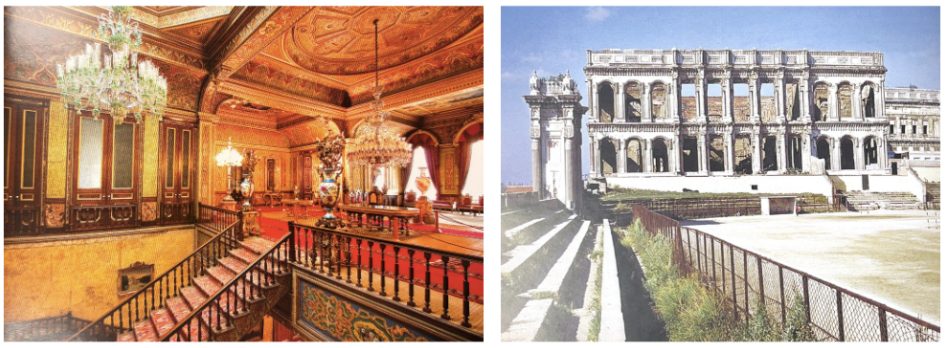
Pictured above: (Left) Beylerbeyi Palace, built in 1864, designed by Sarkis Balian. (Right) The Çırağan Palace designed and built in 1857 by architect Nigoğos Balyan and his brothers Agop (Hagop) and Sarkis Balyan. Source: Western Armenians Throughout History Volume I – (287 – 1850) by Dr. Pars Tuğlacı (2004)
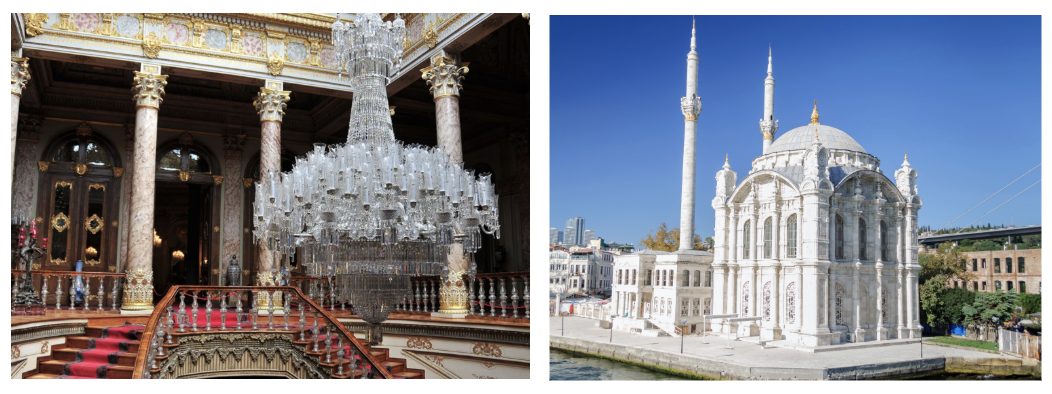
Pictured above: (Left) Dolmabahçe Palace, built between 1843 and 1856, designed by Garabed Balian and Nigoğos Balian. (Right) Ortakoy Mosque, built between 1854 and 1856 by Nigoğos Balian. Source: Britannica and SU Magazine, respectively.
The Dadian family were an Ottoman Armenian family who became key industrial and military suppliers to the empire, especially in gunpowder production, arms manufacturingm and state-run military industries. They were part of the Armenian millet elite, similar in status (but different field) to the Balian architects.
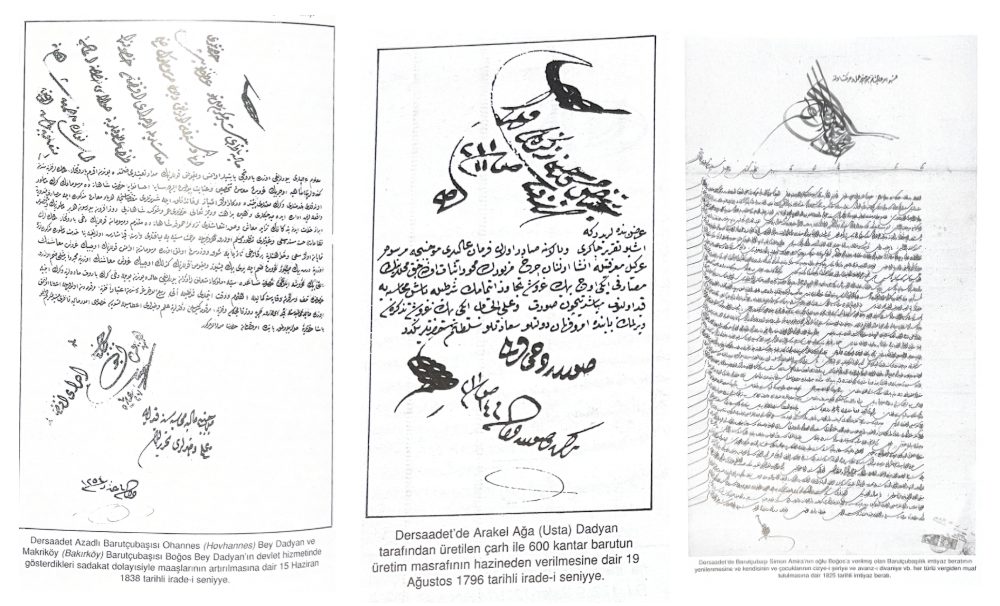
Pictured above: (Left) Imperial decree dated 1838 regarding the increase in salaries of Hovhannes Bey Dadyan, the Chief Gunpowder Maker of Dersaadet (Istanbul), and Boğos Bey Dadyan, the Chief Gunpowder Maker of Makriköy (Bakırköy), for their loyalty in state service. (Middle) Imperial decree dated 1796, concerning the payment from the treasury of the production costs for 600 kantar of gunpowder produced by Master Dadyan. (Right) A 1825 decree renewing the privilege of being the Chief Gunpowder Maker, granted to Boghos Dadyan and exempting him and his children from all taxes, including the jizya-i sharia and avarız-ı divaniye. Source: Western Armenians Throughout History Volume I – (287 – 1850) by Dr. Pars Tuğlacı (2004)
As noted by George Shirinian, former Director of the Zoryan Institute, in the introduction to his book Genocide in the Ottoman Empire: Armenians, Assyrians, and Greeks, 1913–1923, the economic and professional contributions of non-Muslim communities in the late Ottoman Empire were substantial and deeply embedded across key sectors of society. He writes the following: “Non-Muslims were well represented in finance (banking and money-lending), mechanized transport, export-oriented agriculture, and modern industries. They were also prominent in the professions, such as medicine, pharmacy, engineering, law, and teaching.
Ottoman Christians, mainly Greeks and Armenians, represented the majority of officially registered merchants in Constantinople in 1911 — as high as ninety percent. Two-thirds of the largest textile importers were Armenians. Of the 654 wholesale companies in Constantinople in 1911, 528 (eighty-one percent) were owned by ethnic Greeks. Of the forty private bankers in Constantinople in 1912, none had a Muslim name; of those who could be identified with reasonable confidence, twelve were Greek, twelve Armenian, eight Jewish, and five Levantine or European.” (Pg. 4).
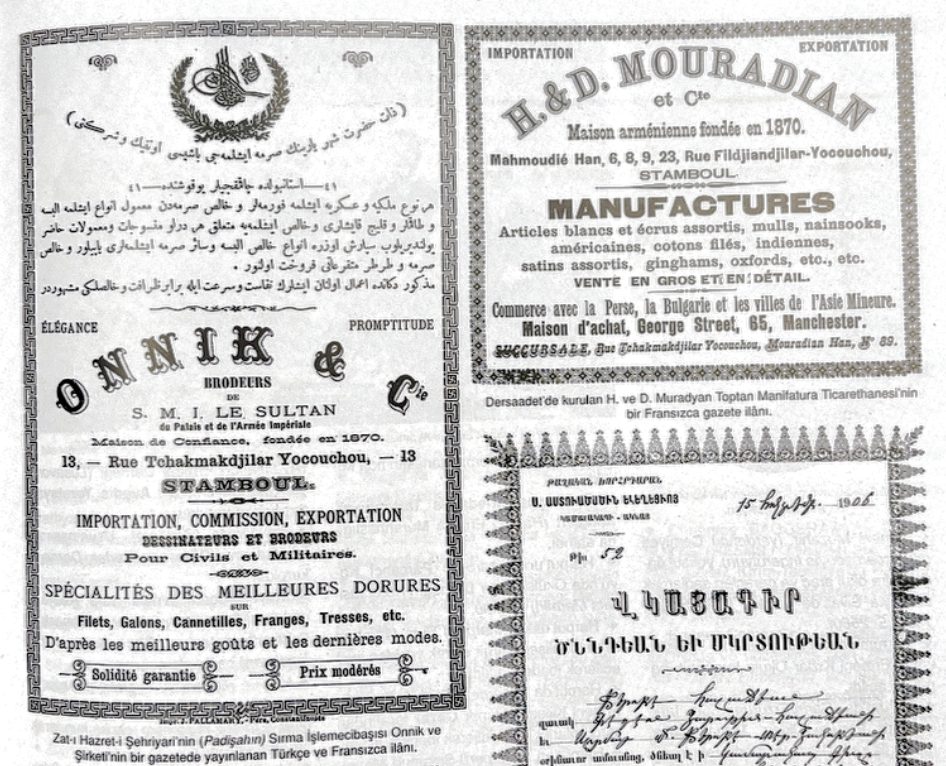
Pictured above: (Left) An advertisement in Turkish and French published in a newspaper for Onnik and his company, the Chief Goldsmith of His Imperial Majesty (the Sultan). (Top Right) An advertisement in a French newspaper for H. and D. Muradyan Wholesale Textile Trading Company, established in Dersaadet (Istanbul). Source: Western Armenians Throughout History Volume II – (1850 – 1890) by Dr. Pars Tuğlacı (2004)
This differentiation fostered a deeply interconnected economy. Urban centers, especially Istanbul, depended on the cooperation of multiple communities whose economic roles complemented one another. Trade, finance, craftsmanship, and administration required constant interaction across religious boundaries. In this sense, the millet system did not isolate communities economically; rather, it created a framework in which diversity could contribute to economic dynamism. Markets, workshops, and state institutions became shared spaces where Armenians, Greeks, Jews, and Muslims interacted regularly, producing a form of everyday coexistence that a modern observer might recognize as functional integration. At the same time, this system did not produce equality. Muslims occupied a privileged legal and political position, and access to certain forms of power remained uneven. Yet the economic interdependence of communities facilitated social interaction and mutual reliance. The stability of this arrangement depended less on complete harmony than on a managed balance, maintained by the Sultan and imperial administration, who had a vested interest in preserving order and ensuring the steady flow of revenue.
The flexibility of the millet system allowed communities to mobilize institutions and networks, encouraging productivity, yet its segmented structure could reinforce boundaries. What is clear is that it sustained a complex, multi-religious economic order over centuries, combining cooperation with hierarchy, a context that makes the later breakdown of Ottoman pluralism and the violence against Armenian, Greek, and Assyrian Christians all the more striking.
Separating from the major urban and economic Armenian actors discussed above, we now turn to everyday life in small towns and villages, including Armenians working as shopkeepers, artisans, and small business owners. We invite you to watch the following video from the Institute’s Clips from the Collection series, featuring selected interview excerpts from Armenian Genocide survivors in our Oral History Collection, offering insight into ordinary lived experience rather than elite professions.
The Zoryan Institute invites you to share this release with five friends for Genocide Awareness Month to help promote understanding and reflection.
We also value your ongoing feedback on this series by submitting your comments to [email protected].