
Day 2: “The Millet System” and Living Together Under Ottoman Rule
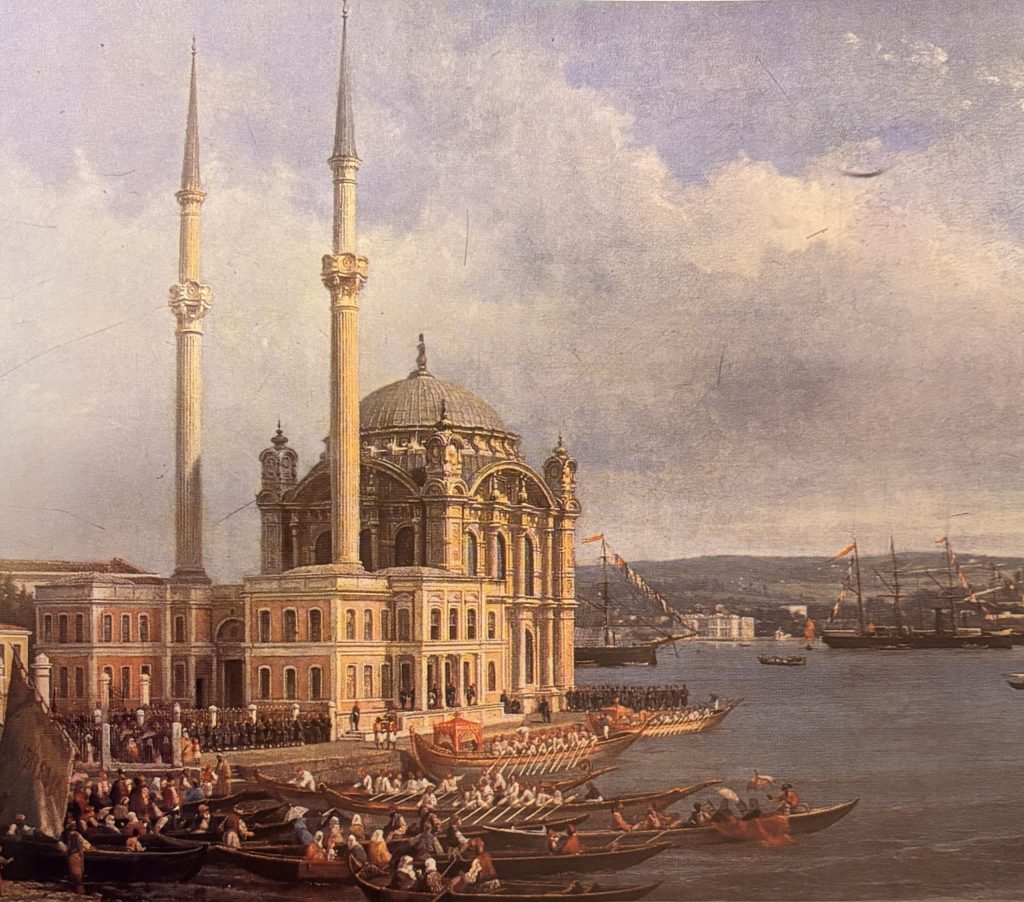
The Grand Mecidiye Mosque in Dersaadet-Ortaköy, built by architect Nigoğos Balyan.
The diverse population of the Ottoman Empire was governed through a structure known as the millet system. Rather than organizing peoplehood by ethnicity or language, the empire classified its subjects primarily according to religious community. Each recognized community, called a millet, was permitted to manage many of its internal affairs while remaining loyal subjects of the Ottoman state. However, the millet system did not create complete equality as we understand it today in the context of Canadian multiculturalism. It did not afford equal individual rights to all Ottoman citizens, as non-muslims were legally classified as dhimmi and were required to pay a special tax known as jizya.
The most prominent millets included the Greek, Armenian, and Jewish communities. Each had a recognized leader who served as an intermediary between imperial authorities and the community itself. For Armenians, this role was held by the Armenian Patriarch of Constantinople; for Greeks, by the Greek Patriarch; and for the Jewish community, by the Chief Rabbi, the Hakham Bashi. These leaders were responsible for representing their communities before the government, organizing schools and charitable institutions, administering family law, managing churches and synagogues (including more than 2,300 Armenian churches), and assisting in the collection of certain taxes.
The millet system functioned as long as the central authority of the Sultan was balanced with the local autonomy of religious communities. The Ottoman government focused primarily on tax collection, security, and political loyalty, while allowing communities to manage many of their internal affairs.
For Ottoman rulers, the system provided an efficient way to govern a vast and diverse population. While non-Muslim groups held a different legal status within the empire, they were generally permitted to maintain their religious institutions, languages, educational systems, and cultural life. This autonomy allowed communities to preserve their identities and develop vibrant intellectual and economic traditions.
Nevertheless, for long periods the millet system provided a framework through which different religious communities—including Armenians—could organize their social and cultural lives while participating in the broader society of the Ottoman Empire. For example, Armenians played significant roles in crafts, commerce, finance, and architecture, interacting daily with Muslim, Greek, and Jewish neighbors in markets, workshops, and neighborhoods. These shared urban spaces created networks of cooperation that helped sustain the empire’s economic life.
The Armenian experience illustrates how this system could create space for cultural development. Over time, Armenians became active participants in the economic and cultural life of imperial cities. Constantinople, in particular, emerged as a major center of Armenian cultural activity. During the eighteenth and nineteenth centuries, Armenian schools—numbering nearly 1,900—expanded, printing presses flourished, literature developed, and Armenian-language newspapers appeared. These developments contributed to what historians often describe as an Armenian cultural renaissance (“Zartonk”) within Ottoman Anatolia.
In the coming days, we will explore the Armenian community in greater detail to indicate how different religious groups coexisted within Ottoman society, and how government institutions and the Sultan helped balance and enable a multicultural social order of stability, one that was able to sustain until the collapse of the Ottoman system and its millet system, leading to the Armenian genocide and the forced deportation of almost 4.5 million non-muslim minorities, including Armenians, Pontic Greeks, and Assyrians from Anatolia.
In today’s Turkey, the situation is different. See Turkish Historian Rifat Bali’s interview with the Zoryan Institute below for a brief reflection on minorities in Turkey.
Subscribe to our ZI e-Chronicles Youtube channel to explore more of the Institute’s academic interviews here.
Stay tuned for our next installment, expanding on the administration of the Millet System. To explore the full series, visit our main page here, where all releases will be collected for easy reading as they become available.