By Karolina Koziura
Introduction
As of October 2026, more than 2,185 cultural heritage sites and 2,686 cultural institutions have been confirmed destroyed or damaged across Ukraine as a result of Russia’s 2022 invasion.[1] Among the deliberately targeted sites have been monuments, museums, artworks, memorial plaques, and crosses commemorating the victims of the Holodomor, the Great Ukrainian Famine of 1932-1933. These acts of destruction should not be understood merely as instances of wartime vandalism. Rather, the targeting of Holodomor memorials reveals the enduring power of denial that has shaped both the history and memory of the famine, and now returns to Ukraine as part of a new cycle of violence (Figure 1). This November, as we commemorate the Holodomor, remembering a history that was systematically denied for decades takes on renewed urgency.
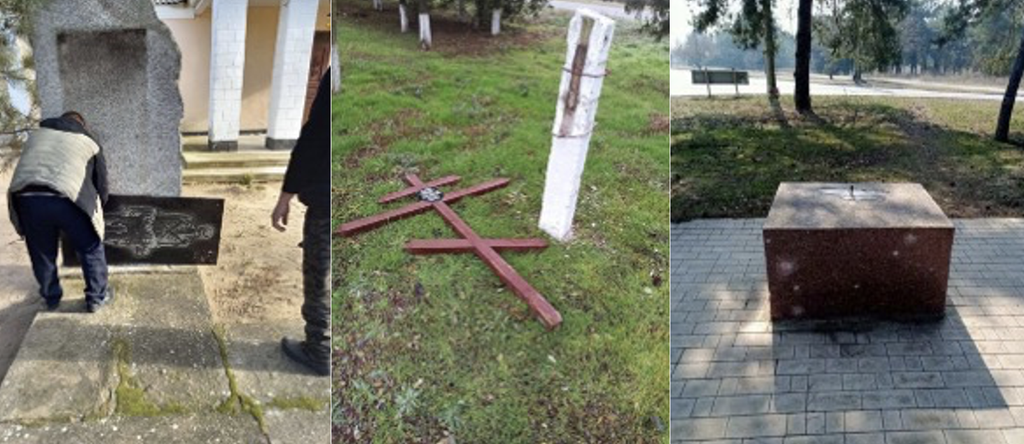
Figure 1: Destruction of famine memorials in eastern Ukraine. Source: Occupied Memory. A project of the Holodomor Museum in Kyiv. https://holodomormuseum.org.ua/proekt/okupovana-pam-iat-znyshcheni-memorialy-zhertvam-holodomoru/.
In Holodomor scholarship, denial has often been understood as a strategy of concealment employed by the Soviet State to obscure its responsibility. Accordingly, the reforms of the late 1980s (known as glasnost and perestroika), followed by the gradual opening of state archives, have often been portrayed as bringing an end to this repressive denial. My research, however, complicates this narrative. Denial was not simply a post-famine phenomenon. Rather, it was a constitutive dimension of violence itself, shaping responses to Soviet policies, constraining forms of resistance, and blocking survivors’ efforts to make sense of their experiences. In Ukraine, denial prevented a full societal reckoning with this painful history. In Russia, it hindered a meaningful transition from the communist past and constrained the development of a democratic future. Beyond the region, denial delayed the recognition of the famine as political violence.
The Soviet denial of famine
The First Five-Year Plan (1928-1933) sought to achieve rapid modernization, industrialization, and the collectivization of agriculture. Collectivization, in particular, embodied what James Scott has described as a “high modernist” ideology.[2] It aimed to radically transform both the natural environment and social life in the countryside by breaking the peasants’ traditional connection to the land, imposing new ways of life, and fostering new rural subjectivity. The rapid pace of environmental and social transformation was driven by the reorganization of individual peasant households into large collective and state farms. Unrealistic procurement quotas imposed on agricultural regions such as the Kuban, the Volga basin, and Ukraine sparked widespread resistance. Even when collective farms met the quotas, authorities frequently raised them further. In Ukraine in particular, Soviet policies took an increasingly violent turn. Mass arrests, executions, deportations of entire families to labor camps in Siberia, attacks on cultural and political elites, and the forced displacement of rural populations became common features of the collectivization campaign. This violence was accompanied by the systematic destruction of the material foundations of peasant life. Livestock was confiscated, homes and churches were destroyed, and in some cases, entire villages disappeared. By the fall of 1932, nearly 80 percent of steppe Ukraine had been collectivized, and reports of starvation and cannibalism were already being recorded by Communist Party members.[3]
Through discursive cleansing, evidentiary control, and moral reframing, Soviet authorities regulated what could be known and politically claimed about the crisis unfolding in the countryside. Bureaucrats carefully described the disaster in official communications as merely “temporary difficulties” or the result of “bad management.” The use of terms such as “starvation” or “hunger” could provoke denunciation and accusations of anti-Soviet activity, often carrying the risk of arrest. At the same time, local and regional state-controlled newspapers portrayed starving peasants as backward provocateurs who resisted modernization and failed to adapt to revolutionary change. At the height of the famine, deaths were not systematically recorded, local registries routinely falsified causes of death, and many victims were buried in unmarked mass graves (Figure 2). According to recent demographic estimates, nearly four million people died in Ukraine during the famine of 1932-1933.[4] Yet the precise number and locations of burial sites will likely never be known.
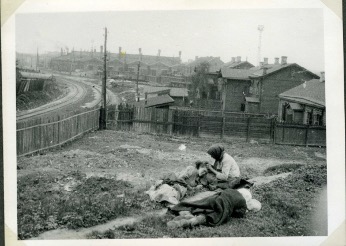
Figure 2: Ukrainian countryside in 1933, Photo by Alexander Wienerberger, Source: Holodomor Photo Directory.
The Soviet denial of the famine transformed as reports of the catastrophe circulated beyond its borders. During the 1930s, an unprecedented number of foreign correspondents, agricultural experts, industrialists, and diplomats were stationed in Moscow, many of whom openly admired the scale and pace of Soviet reforms. Amid the global economic depression, numerous Western observers dismissed reports of famine, describing the crisis as little more than a temporary food shortage. In doing so, they often reproduced a central element of Soviet denial, namely that the starving peasants were guilty of causing their own condition (Figure 3). Among the most influential voices was Walter Duranty, the celebrated Moscow correspondent of The New York Times. Defending Soviet policies, Duranty portrayed the peasantry as an indifferent mass that needed to be “taught a lesson” in order to appreciate the benefits of collectivization. “Russian peasants,” he argued, were “not like American farmers, but more like farm-cattle.”[5] A month later, he accused Gareth Jones, a Western correspondent who had reported on the famine, of exaggerations and sensationalism. “There is no actual starvation or deaths from starvation,” Duranty insisted, “but widespread mortality from disease due to malnutrition.”[6] Such statements did more than justify Soviet policies, they stripped the victims of political agency and moral standing reducing them to obstacles on the path of progress. By recasting starvation as mismanagement and portraying peasants as backward and undeserving, denial was not merely a rejection of evidence, but of the victims themselves, viewing their suffering as a necessary cost of modernization.
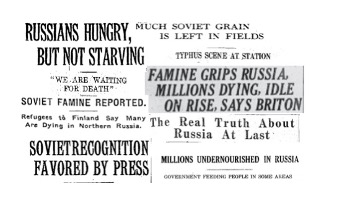
Figure 3: Conflicting headlines of major newspapers outside of the Soviet Union referring to the situation in Ukraine. Source: Collage created by the author.
Over time, denial extended far beyond the suppression of information. By denying victims recognition, it deprived them of the social and cultural practices through which suffering could be acknowledged, mourned, and transmitted to future generations. Decades later, in memoirs and testimonies, survivors recalled that it was forbidden to speak about the suffering or mourn the death of relatives. No crosses were permitted at mass burial sites, nor were mourning rituals or commemorations allowed. Even those living abroad were often afraid to publicly talk about their experiences.[7] The same logic shaped the development of scholarship on the famine. Soviet authorities closely monitored academic life and any attempts to build transnational forms of solidarity through which Ukrainian scholars could contextualize the famine. Denial, in other words, blocked the reckoning with the past and any attempts to fully understand the experiences of those who had suffered.
These efforts extended well beyond Soviet borders. Soviet Secret Police closely monitored the activism of Ukrainian diaspora communities and the work of Ukrainian academic institutions abroad. Recently declassified files reveal the extent of surveillance directed at groups engaged in documenting the famine since the late 1950s. The most extensive operation, code-named Pharisee, was designed to discredit evidence of what Soviet authorities referred to as the so-called “artificial famine in Ukraine of 1932-1933.” According to classified documents from the Secret Police (SBU) archives, the campaign targeted those labeled “Ukrainian bourgeoisie nationalists” who “fabricated documents related to famine” and used so-called “witnesses” to conduct an “anti-Soviet campaign” in the West[8]. One of the outcomes of these efforts was Toronto publication of Douglas Tottle’s Fraud, Famine, and Fascism: The Ukrainian Genocide Myth from Hitler to Harvard (1987), a book intended to expose what its author described as the “political myth” of Ukrainian genocide.[9] The objective of these campaigns was not simply to dispute historical facts but to prevent the emergence of communities of memory capable of recognizing famine victims, preserving their testimonies, and situating their experiences within broader histories of political violence.
The structures of Soviet denial began to weaken in the late 1980s. The Chernobyl nuclear disaster of 1986 and the Soviet State’s delayed response to the catastrophe triggered a broader political awakening. In Russia, the Memorial Society was founded to document the full scale of Stalinist repressions and recover the histories of its victims. In Ukraine, dissidents and historians called for the collection of famine testimonies. People began to gather at burial sites to mourn relatives who had died during the famine and local historians began collecting testimonies as memoirs and recollections appeared in regional newspapers. For the first time in decades, famine victims could begin to re-enter public memory not as anonymous casualties but as individuals whose lives, deaths, and suffering demanded acknowledgment (Figure 4).
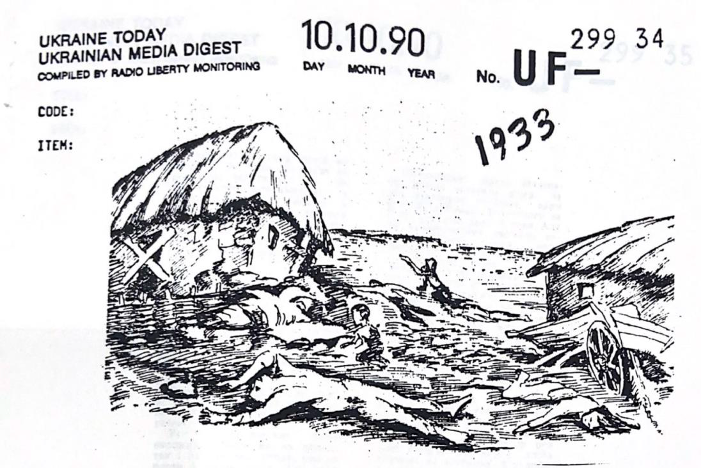
Figure 4: Depiction of the famine in the local Ukrainian press in 1988, Source: Open Society Archives in Budapest, Hungary.
Unsettled legacy of Soviet past
The collapse of the Soviet state did not end the denial of the famine. Rather, denial adapted to the new political environment. As archival evidence became increasingly difficult to suppress and public commemoration gained legitimacy, the focus moved away from concealing the famine itself and toward shifting responsibility. Members of Soviet Ukraine leadership quickly recognized this changing political reality. Among them was Leonid Kravchuk, the future president of independent Ukraine, who only a few years earlier had overseen the Pharisee campaign. Now, however, he joined calls for a national memorial to the famine victims, authorized the opening of Soviet archives, and supported the publication of the first collection of famine-related documents. Paradoxically, the very denial that Kravchuk had helped sustain as a Communist official became, in the transitional politics of the late Soviet period, a resource through which he could distance himself from the crimes of his predecessors and establish political legitimacy in an emerging independent Ukraine. Recognition of the victims thus unfolded alongside a reconfiguration of responsibility.
As a result, those who had long been excluded from public mourning and historical inquiry increasingly became central figures in debates about memory and national identity. The post-1991 Russian-Ukrainian memory wars over the famine illustrate this transformation. The more the Ukrainian state institutionalized remembrance of the famine, the stronger the resistance from Russia grew. Tensions reached a peak during the presidency of Victor Yushchenko, when the history of the famine and the suffering of its victims were elevated to the center of national memory (Figure 5). Across Ukraine, particularly in the eastern parts of the country, new monuments and memorial plaques were erected.
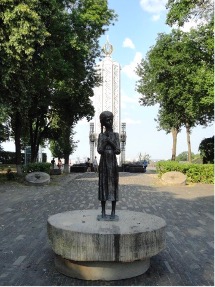
Figure 5: The National Museum of the Holodomor-Genocide and the Bitter Memory of Childhood Statue in Kyiv, Source: Photo by the author, July 2019.
In response, the Russian state did not deny that famine had occurred. Instead, it challenged the distinctiveness of the Holodomor, portraying it as just one of several Soviet famines[10]. In this interpretation, the famine remained a tragic yet justifiable consequence of modernization rather than a form of political violence directed against specific populations. The international public opinion largely supported the Russian framing of the famines, recognizing the Holodomor along with other famines as “common Soviet tragedies.” Denial thus adapted once again, shifting from the question of victim existence to contesting the meaning of their suffering and responsibility for it.
In recent years, the short window of democratic possibility to revise the interpretation of the past was quickly closed. On February 24, 2022, Russia started its full-scale invasion of Ukraine, prompting the reclosure of archives, the persecution of scholars opposing the government, the dissolution of Memorial Society, and transformation of universities into sites of propaganda and military recruitment. Following Russia’s invasion, numerous states and international organizations, in acts of solidarity with Ukraine, have recognized the Holodomor as genocide. At the same time, mass violence, the destruction of civilian infrastructure, forced displacement, and hunger once again have become realities in occupied territories. The Holodomor returned to the public discourse not merely as a historical event but as a framework through which Ukrainian suffering became historically and politically intelligible. Yet recognition has not ended denial. “Violence,” as noted by Yaroslav Dashkevych, a renowned Ukrainian Armenologist, “is frequently masked by empty democratic statements.”[11] While discussing the Armenian genocide during a 2005 conference in Lviv, he remarked that only mutual solidarity and support can challenge oppressive denial and ignorance.
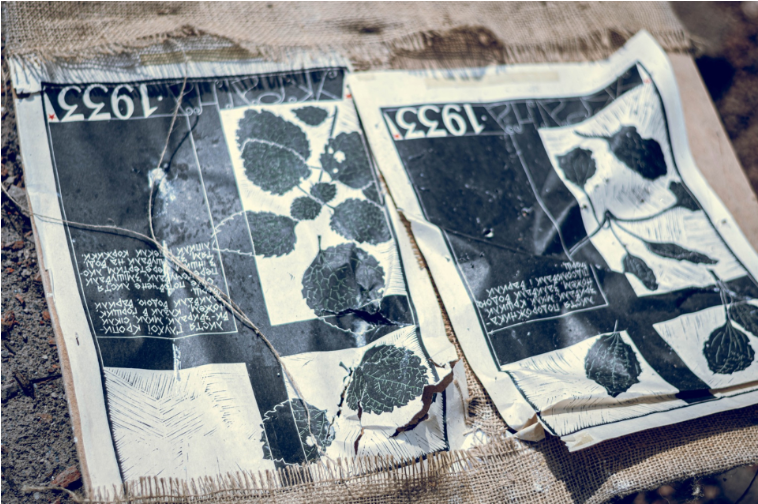
Figure 6: The rescued linocuts of Nikolai Bondarenko from his series Ukraine 1933: A Cookbook, Source: Ministry of the Internal Affairs, August 2023
The return of denial
On July 29, 2023, a Russian rocket struck a building in Sumy that housed the Holodomor Resistance Research Center. The building contained a unique exhibition of linocuts by Nikolai Bondarenko, “Ukraine 1933: A Cookbook.” Created in 1993, the series drew on stories Bondarenko had heard from his grandmother, neighbors, and relatives. Through the collection of oral testimonies and the examination of archival documents, Bondarenko focused on the foods people were forced to consume in order to survive the famine: bark and tree leaves, herbs, roots, and cakes made from ground acorns. His linocuts transformed these accounts of extreme deprivation into a visual testimony of the suffering and resilience of those who survived the Holodomor. Although severely damaged during the bombing, his artworks survived the bombing (Figure 6). The survival of Bondarenko’s work carries a significance that extends beyond the physical preservation of artworks. Created as an act of remembrance, the series bears witness to experiences that were once suppressed and denied. Its survival amid Russia’s ongoing destruction of Ukrainian cultural heritage also speaks to the resilience of historical memory and to the determination to preserve and transmit the experiences of famine survivors. By targeting monuments, memorial plaques, and commemorative crosses, perpetrators have reactivated an older imperial logic of denial, seeking to disrupt the continuity between past and present forms of suffering. Yet this is not simply a repetition of earlier strategies. As military violence has unfolded alongside the destruction of cultural heritage, denial once again has become a rejection of historical fact as well as contemporary lived reality. Today, as in the 1930s, the primary target has been not only the truth about violence, but also the visibility of its victims, the recognition of their suffering, and the meaning attached to their experiences (Figure 7).
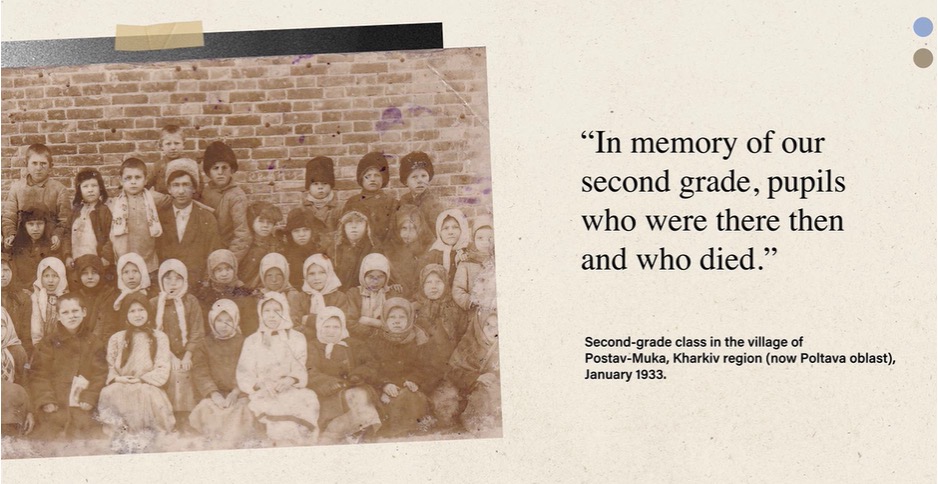
Figure 7: Photo featured in Famine as Genocide: The Holodomor in Ukraine, an online course accessible on Coursera.
[1] Data provided by the Ministry of Culture of Ukraine, Accessed November 19, 2026.
[2] James C. Scott, Seeing Like a State: How Certain Schemes to Improve Human Conditions Have Failed. Oakland, CA: University of California Press, 1998.
[3] On the detailed history of the famine in Ukraine, see Anne Applebaum, Red Famine: Stalin’s War on Ukraine. New York: Doubleday, 2017; Stanislav Kulchytsky, The Famine of 1932-1933 in Ukraine: An Anatomy of the Holodomor. Edmonton: Canadian Institute of Ukrainian Studies Press, 2018.
[4] Oleh Wolowyna, Nataliia Levchuk, and Omelian Rudnytskyi, et al, “Demography of Man-made Human catastrophe: The Case of Massive Famine in Ukraine 1932-1933.” Canadian Studies in Population 42(1-2): 53-80.
[5] Walter Duranty, “Russia’s Peasant: Hub of a Vast Drama,” The New York Times, February 5, 1933.
[6] Walter Duranty, “Russians Hungry, But Not Starving,” The New York Times, March 30, 1933.
[7] For more on the transnational processes of the formation of the Holodomor memory see my article “Towards the Public Memory of Holodomor: The Famine Commemorative Genre and the Ukrainian Diaspora.” Memory Studies 18(1): 22-43.
[8] Haluzevyi derzhavnyi arkhiv Sluzhby bezpeky Ukraїni (HDASBU) f. 16, op. 1, spr. 1255, ark. 0024–25.
[9] For more on operation Pharisee, see my article “The Afterlife of Secret Police Files and the (Re)reading of Famine Documents in Ukraine.” In Interrogating the Interrogators: History, Politics, and the Opening of Soviet Secret Police Archives in Ukraine, edited by Michael David-Fox and Vanessa Voisin. Pittsburgh, PA: Pittsburgh University Press, Kritika Historical Studies 2026.
[10] On the comparative study of all Soviet famines, see Andrea Graziosi and Frank E. Sysyn, Communism and Hunger: The Ukrainian, Chinese, Kazakh, and Soviet Famines in Comparative Perspective. Edmonton: University of Alberta Press 2016.
[11] Yaroslav Dashkevych, “Henotsyd, jak metod imperskoi polityki.” In: Virmeny w Ukraini. Lviv: Logos, 2012, p. 1227.