By: Prof. Bree Akesson
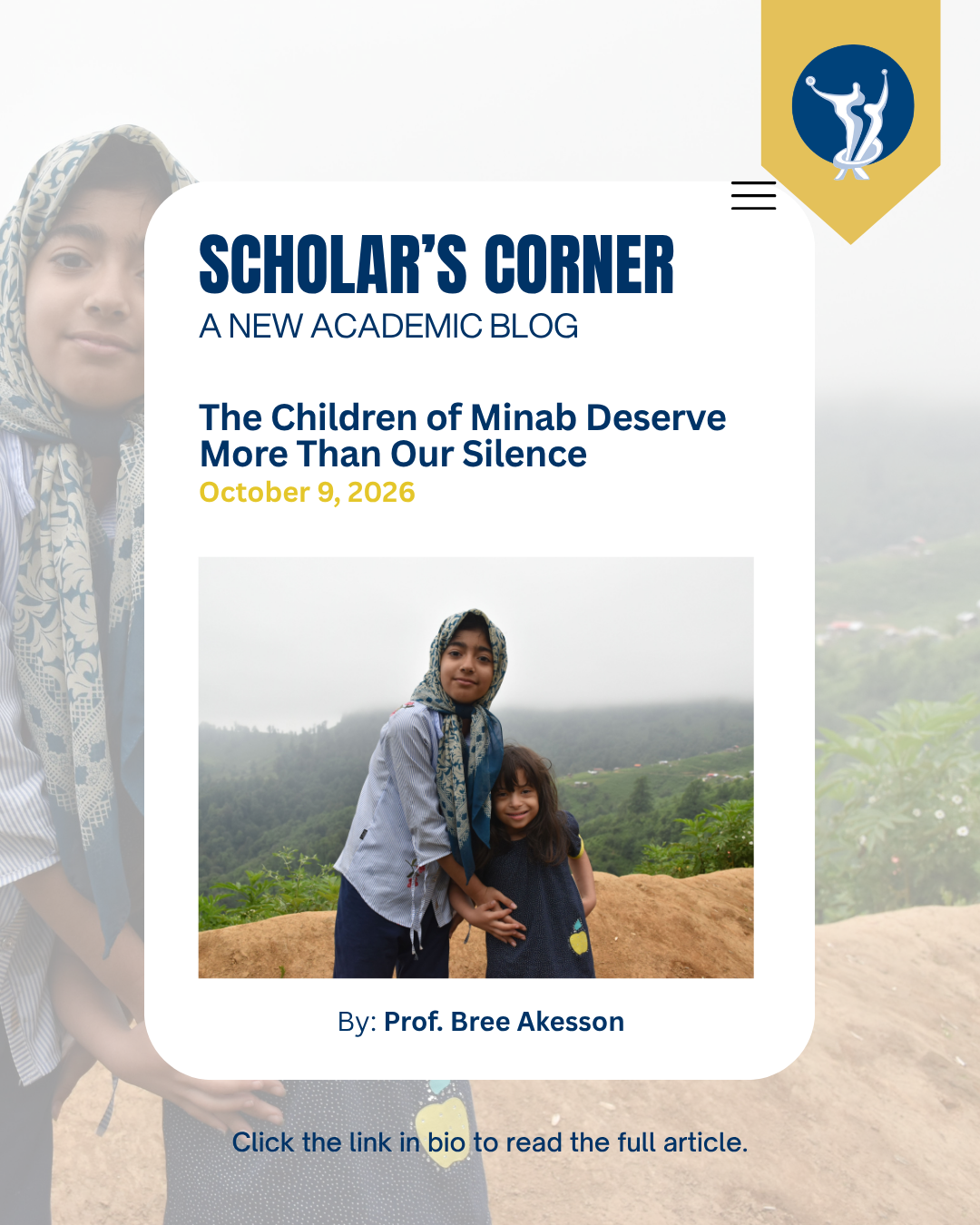
Most children in Iran are back in their classrooms. But in Minab, a city in the country’s south, students gather only briefly at a new school building to hear the first bell ring before returning home for online classes. Their old elementary school, Shajareh Tayyebeh, still lies in ruins nearby.
On February 28, 2026, that school was full of children. Some were still learning to write their names, while others were dreaming of futures in teaching and medicine. Their parents had kissed them goodbye at the door, never imagining it would be the last time. February 28, 2026 was also the first day of the US-Israeli war on Iran, and when two American Tomahawk cruise missiles struck the school. 156 people were killed including 120 children and 26 teachers. The UN condemned the attacks, as well as Iran’s retaliatory strikes across the region. UNESCO called the killing of pupils in a place dedicated to learning “a grave violation of the protection afforded to schools under international humanitarian law.”
As a researcher who has spent years studying the psychological toll of war on families, I have read accounts of devastating loss. There is a particular kind of grief that belongs to parents who send their children to school — a place of safety and hope for the future — and never see them again. Research consistently shows these parents face profound, lasting consequences: complicated grief, traumatic stress responses, and depression. In Minab, that wound belongs to an entire community.
Seven months on, the facts are not in serious doubt. In September, a UN fact-finding mission found reasonable grounds to conclude the strike was a war crime. It said the US “failed in its obligation to do everything feasible to verify” the target, and that this failure “went beyond mere negligence.” Officials involved in the Pentagon’s own investigation described its findings to Bloomberg News as “a cascade of preventable failures.” That report has been all but finished for months, yet it has not been released.
The US’s response has been shameful. In March, President Donald Trump first suggested Iran was to blame. In July, he told Fox News, “I don’t think anybody’s going to ever be able to say what happened there.” When asked about the Pentagon’s findings in September, a senior administration official only said, “The United States does not target civilians.”
Some will call this the fog of war, but the evidence says otherwise. The Shajareh Tayyebeh school was not a concealed or ambiguous target. Satellite imagery confirms it had been converted into a school by October 2015, a clear civilian institution for over a decade. The school had its own website and was labeled on Google Maps. Yet the main US intelligence database used for targeting still listed the site as a military facility. The record points to a failure of due diligence, made worse by cuts to the Pentagon’s civilian-protection staff under Secretary of War Pete Hegseth and a demand to hit more than 1,000 targets in the war’s first 24 hours.
No compensation can restore what was taken from these families. There is no dollar figure that returns a child. Still, compensation matters. It tells families their loss has been counted. In 2021, after a US drone strike in Kabul killed 10 civilians, including seven children, the Pentagon admitted its mistake within weeks and offered condolence payments.
Canadians should feel this particularly keenly. Canada is home to the world’s fourth-largest Iranian diaspora. Many have family in cities like Minab. For them, the grief in Minab is their own.
This community has been here before. In January 2020, Iran’s Revolutionary Guard shot down Ukraine International Airlines Flight PS752, killing all 176 people on board. Of those, 138 were traveling to Canada, including 55 Canadian citizens and 30 permanent residents, most of them Iranian-Canadians. Iran denied responsibility at first, then admitted to it three days later. Canada spent years demanding accountability, transparency, and compensation, and rightly so. Seven months after Minab, the US has yet to make even that first admission. Accountability is not a principle we apply selectively to adversaries.
The US must do three things. It must release the Minab investigation in full. It must say, clearly and publicly, that American forces killed these children, that the intelligence was outdated, and that the safeguards meant to protect civilians were weakened before the bombs fell. And it must compensate the families without conditions. Canada should publicly call for all three, holding the US to the standard it set for Tehran after PS752.
The children of Shajareh Tayyebeh were not combatants. They were not collateral. They were children going to school on a Saturday morning. The very least we owe their families is the truth, an admission of responsibility, and compensation.
Bree Akesson is the Canada Research Chair (Tier II) in Adversity and Wellbeing and a Full Professor at Wilfrid Laurier University.