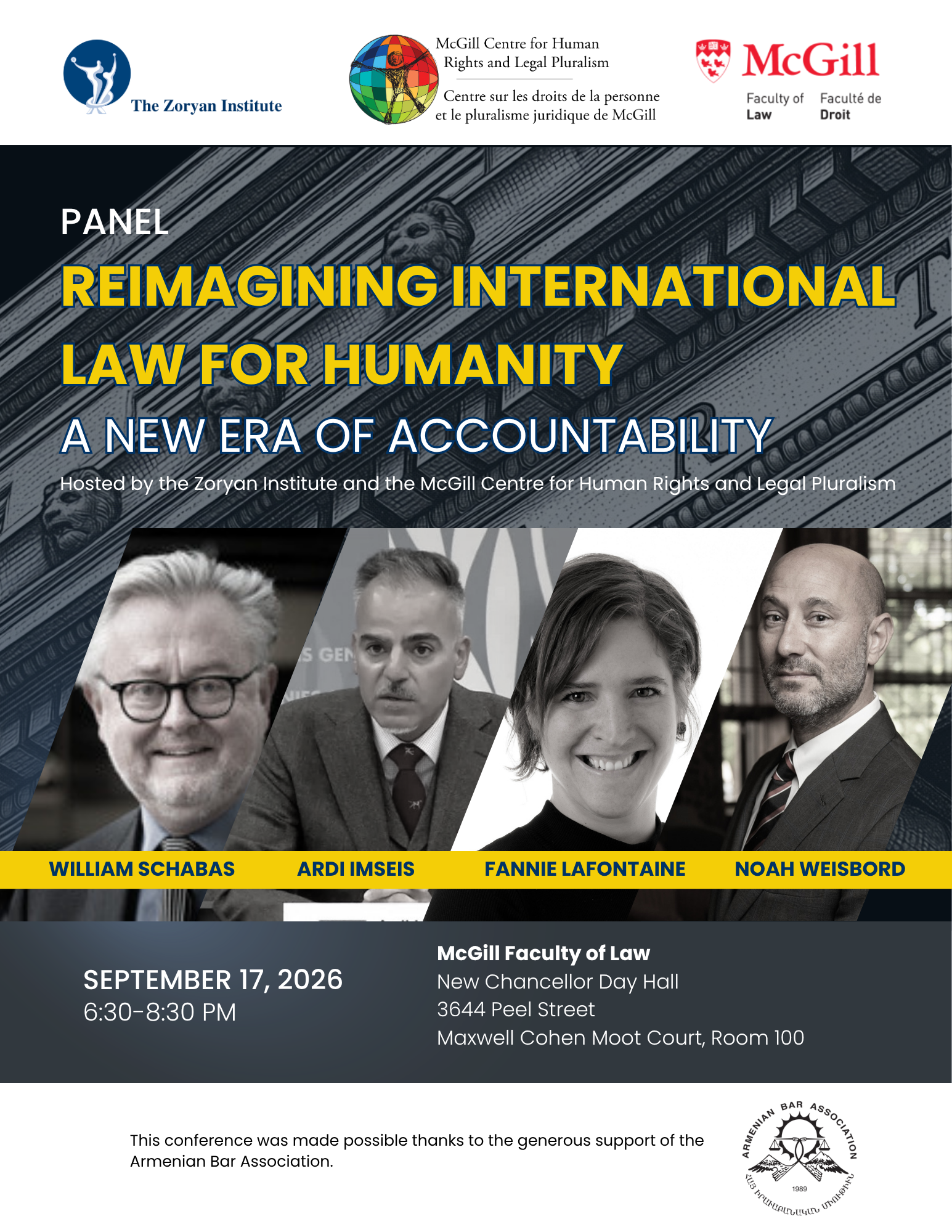
September 4, 2026 (TORONTO): The Zoryan Institute and the McGill Centre for Human Rights and Legal Pluralism will host a timely panel discussion examining the future of international law in an increasingly challenging global environment. The panel will be taking place on September 17, 2026, at McGill’s Maxwell Cohen Moot Court from 6:30-8:30 pm EST.
Titled “Reimagining International Law for Humanity: A New Era of Accountability”, this panel will bring together renowned international human rights lawyers, including Prof. William Schabas, Prof. Fannie Lafontaine, and Prof. Ardi Imseis as panelists, and Prof. Noah Weisbord as moderator, to consider whether the international legal order established in the aftermath of the Second World War remains capable of addressing today’s most serious crises.
From Russia’s invasion of Ukraine and atrocities in Sudan and the Middle East, to the dissolution of Nagorno-Karabakh, fundamental principles of international law are facing unprecedented challenges. The panel will explore the growing gap between international legal commitments and their enforcement, while considering pathways toward stronger accountability and renewed faith in international law.
The panel was made possible thanks to the generous support of the Armenian Bar Association.
Speaker Bios
PROF. WILLIAM SCHABAS
Panelist
William A. Schabas is professor of international law at Middlesex University in London, emeritus professor at Leiden University and the University of Galway, distinguished visiting faculty at the Paris School of International Affairs, Sciences Po, associate tenant at 9BR barristers chambers in London, and an Academic Board Member of the Zoryan Institute.
The third edition of his book Genocide in International Law was published in February 2025. Other recent publications include The International Legal Order’s Colour Line (Oxford, 2023), The Customary International Law of Human Rights (Oxford, 2021) and the published version of the course he delivered at the Hague Academy of International Law in January 2021 entitled Relationships between International Criminal Law and Other Branches of Public International Law.
He has appeared as counsel before the International Court of Justice and the Grand Chamber of the European Court of Human Rights in cases involving the Genocide Convention. Professor Schabas is an Officer of the Order of Canada and a member of the Royal Irish Academy. In 2014 he served as chairman of the UN Commission of Inquiry into the Gaza conflict.
PROF. ARDI IMSEIS
Panelist
Dr. Ardi Imseis is Associate Professor at Queen’s Law School and a scholar-practitioner of public international law. He is a former UN official with UNRWA and UNHCR (2002-2014), as well as a Member of the UN commission of inquiry on Yemen (2019-2021). He has served as legal counsel and advocate in cases before the International Court of Justice and has provided expert testimony in his personal capacity before other high-level bodies, including the UN Security Council, UN Human Rights Council and UN Committee on Economic, Social and Cultural Rights. Among other things, he is author of The United Nations and the Question of Palestine (Cambridge University Press 2023), he is former Editor-in-Chief of the Palestine Yearbook of International Law (Brill; 2008-2019), and Harlan Fiske Stone Scholar and Human Rights Fellow, Columbia Law School. Professor Imseis holds a Ph.D. (Cambridge), an LL.M. (Columbia), LL.B. (Dalhousie), and B.A. (Hons.) (Toronto).
PROF. FANNIE LAFONTAINE
Panelist
Fannie Lafontaine is a lawyer, full professor in the Faculty of Law at Laval University, and Canada Research Chair in International Criminal Justice and Human Rights.
She is co-director of the Centre de droit international et transnational at Laval University and is the founder and co-director of the International Criminal and Humanitarian Law Clinic. She is also the recipient of the tribute to social innovations award from the Laval University.
She acts as an expert and consultant in international cooperation projects and for organizations dedicated to the protection of human rights.
She has worked at the Office of the UN High Commissioner for Human Rights, on the International Commission of Inquiry on Darfur and in NGOs and law firms. From 2015-2020, she acted as independent civilian observer of a criminal investigation into criminal acts alleged to have been committed by members of different police forces against members of First Nations in Quebec, with her reports made publis in 2016 and 2020. She was also the lead drafter of the National Inquiry on Missing and Murdered Indigenous Women and Girls’ Supplementary Report “Legal analysis on genocide”.
PROF. NOAH WEISBORD
Moderator
Noah Weisbord is Professor of Law at McGill University. His work spans criminal law, international criminal law, and the law governing the use of force, with a particular focus on accountability, intergroup conflict, and the future of legal responsibility in an age of technological change.
He has participated in diplomatic negotiations that led to the definition and activation of the crime of aggression at the International Criminal Court, and is the author of The Crime of Aggression: The Quest for Justice in an Age of Drones, Cyberattacks, Insurgents, and Autocrats (Princeton University Press, 2019; paperback edition, 2025). His work has also appeared in journals including the American University International Law Review, Journal of Human Rights Practice, Cardozo International and Comparative Law Review, Harvard International Law Journal, Columbia Journal of Transnational Law, Law and Contemporary Problems, McGill Law Journal, and Queen’s Law Journal.
Professor Weisbord serves on the Council of Advisors on the Application of the Rome Statute to Cyberwarfare and has participated in expert consultations convened by institutions including Chatham House, the Council on Foreign Relations, the United States Institute of Peace, and the Assembly of States Parties to the International Criminal Court. His commentary on international and criminal law has appeared in media outlets including The New York Times, The Globe and Mail, Le Devoir, CBC, CTV, Global News, and the BBC.