
By: Gianluca Pantaleo, McGill University, Doctor of Civil Law (DCL) Student
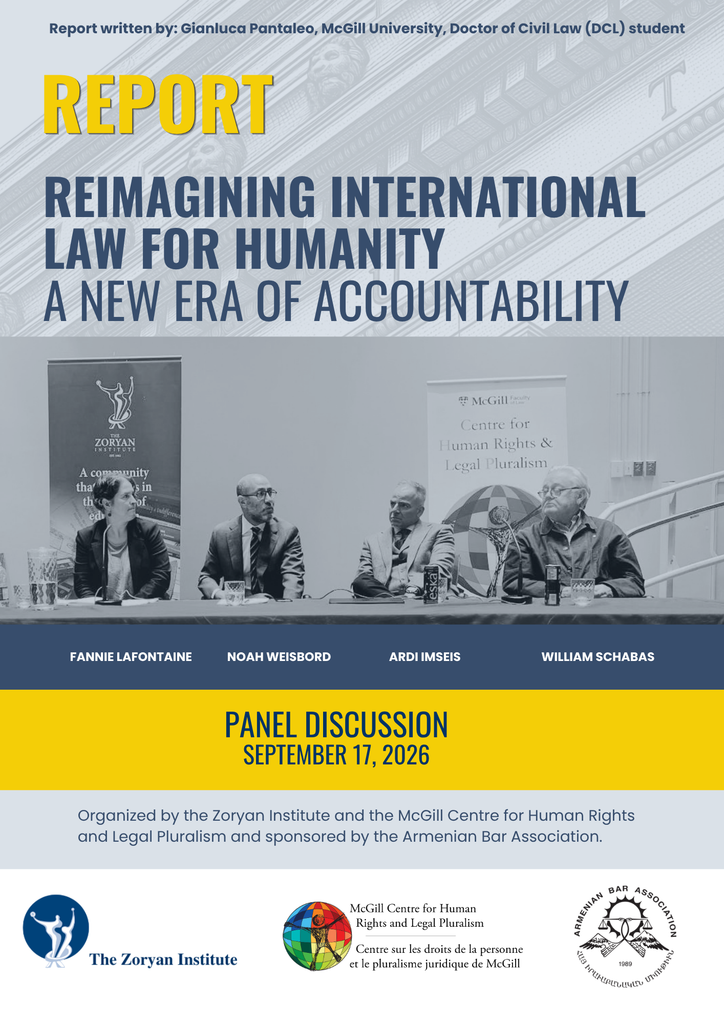
On September 17, 2026, the Zoryan Institute and the Centre for Human Rights and Legal Pluralism (CHRLP) hosted the event “Reimagining International Law for Humanity: A New Era of Accountability” at McGill University, with the generous support of the Armenian Bar Association. The event brought together a large audience of first- and second-year law students, along with international law practitioners and scholars, to discuss whether the international legal order still has the capacity to promote accountability. The panel was composed of Professor William A. Schabas (Université de Montréal, Leiden University, and Middlesex University), Professor Ardi Imseis (Queen’s University), and Professor Fannie Lafontaine (Université Laval), and was moderated by Professor Noah Weisbord (McGill University).
After opening remarks by Professor Alana Klein (McGill University) and Megan Reid (Executive Director, Zoryan Institute), the stage was set with a reflection: the increasing number of conflicts and the insufficient response of the international legal system in promoting accountability are raising concerns about its credibility, especially for the most vulnerable, who continue to suffer the consequences of these conflicts. This credibility, and the hope that the system will prevent atrocities and address responsibility for past ones, invites a reflection on how the system has worked so far and on its prospects for the future, if that hope is to be kept alive.
Key Themes
1. Rupture or Resilience?
That the international legal system, built in response to the Second World War to prevent atrocities, is in crisis, perhaps now more than ever, is a common trope. Professor Weisbord asked the panelists to consider whether, in light of recent conflicts including those in Ukraine, Palestine, and Sudan, we are shifting from a state of crisis to a point of rupture: a collapse of the system as we have known it.
The panelists agreed that international law has been imperfect and incomplete from the outset. As Professor Imseis explained, it is built upon a tension between the prominent role of states in the system and the normativity of the legal order, which states are bound to obey. Despite renewed disenchantment with the effectiveness of international criminal courts and their enforcement capacity, the system has proved resilient and has helped prevent another world war, as Professor Schabas noted.
What is being shaken, according to Professor Lafontaine, is the hegemony of Western countries in the system and the hope that it can prevent atrocities such as genocide. This hope, she emphasized, is where energies should be directed to ensure the system’s resilience and future.
2. Double Standards and the Counter-Hegemonic Use of International Law
This tension plays out significantly in the application of double standards, as seen, for example, in the cases of leaders of powerful militaries who are able to escape accountability.
According to Professor Imseis, these double standards are built into the system, as it was based on Western hegemony. However, recent events such as the broad condemnation of Russia’s aggression against Ukraine in 2022 could pave the way for the Global South to use international law as a counter-hegemonic tool to make it better and gradually do away with double standards. Professor Lafontaine turned the question around, asking whether international law can survive moving away from double standards. The International Criminal Court (ICC), long accused of trying only individuals from Africa, has tried to move to other situations, including Israel, and has consistently been the target of attacks by powerful states such as the United States.
3. The Turn to the International Court of Justice
Some institutions, however, have proved less vulnerable to accusations of double standards, such as the International Court of Justice (ICJ). Professor Schabas emphasized that in recent years a large number of states have sought advisory opinions from the Court and an ever-growing number of states are intervening as third parties in its proceedings. A new pattern seems to be emerging, in which states prefer a judicial institution, referring to the ICJ questions once left to political bodies, such as the Occupied Palestinian Territory, climate change, the right to strike, and genocide.
4. Accountability Beyond International Criminal Tribunals
While the ICJ is experiencing a revitalization, international criminal courts have proven unable to hold perpetrators accountable while violence is still unfolding. As the initial enthusiasm that sustained the creation of new international criminal tribunals has faded, Professor Schabas questioned whether international criminal justice has a future at all.
Professor Lafontaine still saw a role for the ICC, which is trying to move beyond double standards despite recent sanctions by the United States, but argued that, when it comes to accountability, the nearly exclusive focus on international criminal tribunals misses the broader picture. The whole ecosystem has evolved to include other actors and institutions. These include independent investigative mechanisms and clinics that document events on the ground and conduct open-source investigations. This real-time documentation has the power to change the narrative among the public and in the media.
5. Revitalizing International Law by Addressing Historical Wrongs and Naming Atrocities
Addressing historical wrongs can also play a decisive role in revitalizing international law. As Professor Schabas claimed, looking at the past and deciding that certain conduct, such as the slave trade, constituted a crime against humanity, and attaching consequences to it, can advance the interests of international justice.
How best to do this remained an open question. Professor Imseis wondered whether the issue should be addressed from the perspective of morality, while Professor Schabas favoured changing the law itself, recalling that retroactive laws were applied in the past, as at the Nuremberg Trials.
Naming atrocities is also of critical importance, Professor Lafontaine argued, since truth is essential to reconciliation, even if legalism can obscure the debate. Recognition of the violence as a crime is often demanded by victims themselves, as shown by Indigenous peoples in Canada and by women in Afghanistan. Professor Imseis shared this view, stressing that for Armenians, the recognition of the genocide is a vindication of their experience, with a ripple effect across generations.
Key Takeaways
The audience raised questions related to the key themes of the conference, including what international law can do to defend itself, and how civil society can contribute to ensuring that the principles of justice and accountability on which it is based continue to be upheld and applied. The audience also asked how to hold accountable third states that continue to support states committing genocide, and about the failure of the international legal order to address greenhouse gas emissions.
One key takeaway is that the international legal system, albeit imperfect, is not at a point of collapse, and that it has proved resilient. International law was created by states to respond to the needs arising from the violence of the Second World War and to ensure stability. It is not self-executing: to adapt to new realities that did not exist at the time, such as climate change, it needs the active engagement of the actors within it. While there is no doubt that it is facing a crisis, the system has held.
Another key takeaway is that this resilience comes from actors initially left at the margins of the system itself, who are reappropriating it and challenging the dominance of those who had a decisive say in designing it. The Global South is making its voice increasingly heard within the international legal system, to have past wrongs addressed, such as through the recognition of the slave trade as the gravest crime against humanity, and to challenge the hegemonic voice of Western countries and the system’s double standards. At the same time, civil society efforts remain critical to upholding the principles of international law and changing dominant narratives.
Finally, these dynamics have also changed where and how accountability is pursued. New bodies and civil society initiatives are undertaking consequential documentation efforts to promote knowledge and to name past wrongs, while states are increasingly bringing before the ICJ critical questions once left to political bodies, including the responsibility of third states that support genocide, as in Nicaragua’s case against Germany.
These are promising signs of a system poised to move, slowly and imperfectly, towards greater accountability for atrocities.