The pursuit of academic work and historical truth must remain independent of shifting political circumstances or political expediency, especially regarding matters that affect humanity.
The International Institute for Genocide and Human Rights Studies (IIGHRS), a division of Zoryan Institute, reaffirms a core principle of scholarship.
There has recently been a period of tension observed between academia and public policy discussions in the Republic of Armenia. A policy that has long pursued the affirmation of the Armenian Genocide and the independence of Artsakh has, in recent months, undergone adjustments due to geopolitical considerations. The acknowledgement of the Armenian Genocide and its affirmation have always been politically charged, and it is therefore not surprising that such developments have generated discussions and concerns within scholarly and public communities today.
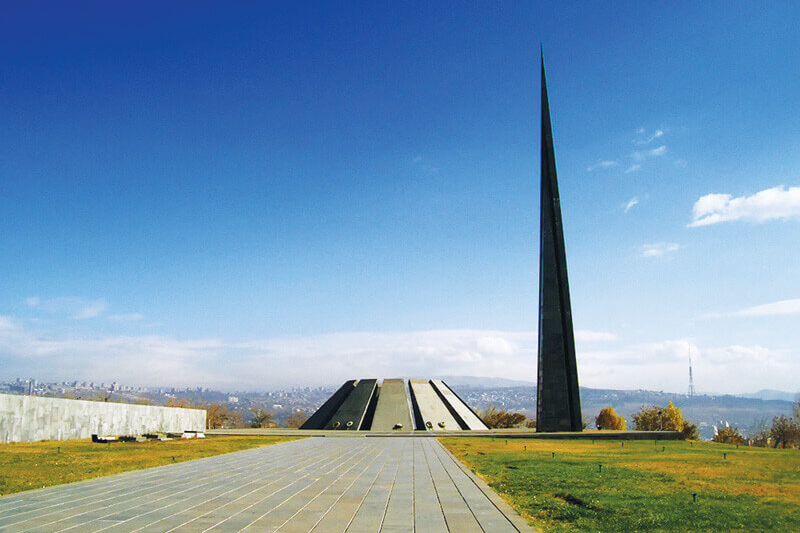
It is within this context that the Director of the Armenian Genocide Museum-Institute, Dr. Edita Gzoyan, submitted her resignation from the position this week. Dr. Gzoyan is also a graduate of the Genocide and Human Rights University Program (GHRUP) of the Zoryan Institute. While governments often face complex geopolitical realities and difficult policy decisions, the Zoryan Institute remains steadfast in its belief in academic freedom and that the work of historians and researchers must remain guided by evidence, documentation, and rigorous academic inquiry. The Institute, therefore, encourages scholars and researchers at AGMI and across Armenia to continue their scientific and educational work with dedication to scholarly standards, despite the new realities they are facing.
Over many decades, the field of Genocide Studies has developed into a global area of research supported by extensive archival investigation and international scholarship. The history of the Armenians in the late Ottoman Empire has been examined through the opening of numerous archives across Ottoman-Turkey, the Americas, Germany, Austria, and the rest of Europe, and through the work of scholars from many countries and disciplines. This body of research forms a substantial and well-documented part of the international academic record(s) concerning the incontestability of the Armenian genocide.
At moments when political realities and historical research intersect, it is important to reaffirm that scholarship, grounded in evidence and documentation, must continue to inform our understanding of the past. Institutions and scholars engaged in the study of genocide should continue their work documenting history, advancing research, and contributing to the global effort to better understand and prevent mass atrocities, wherever they occur, whether in societies historically identified as victims or those associated with perpetrating states.
Museums, research institutes, and academic centers exist to preserve documentation, encourage research, and educate the public. Their credibility depends on their ability to operate with intellectual independence and scholarly integrity. The Institute expresses its hope that continued dialogue and mutual respect for historical scholarship will contribute to long-term understanding and stability in the region, and that historical knowledge can ultimately support reconciliation and peaceful relations between societies. These principles apply equally to scholars and institutions in all countries connected to this history.
The Institute further believes that genuine reconciliation and stable neighbourly relations between Armenia and Turkey can only emerge when scholars and academic institutions on all sides adhere to the same standards of rigorous scholarship, open archival inquiry, and intellectual integrity. Only through such shared scholarly commitments can history cease to function as a stumbling block between nations, and instead become a foundation for understanding, dialogue, and responsible engagement with the past.