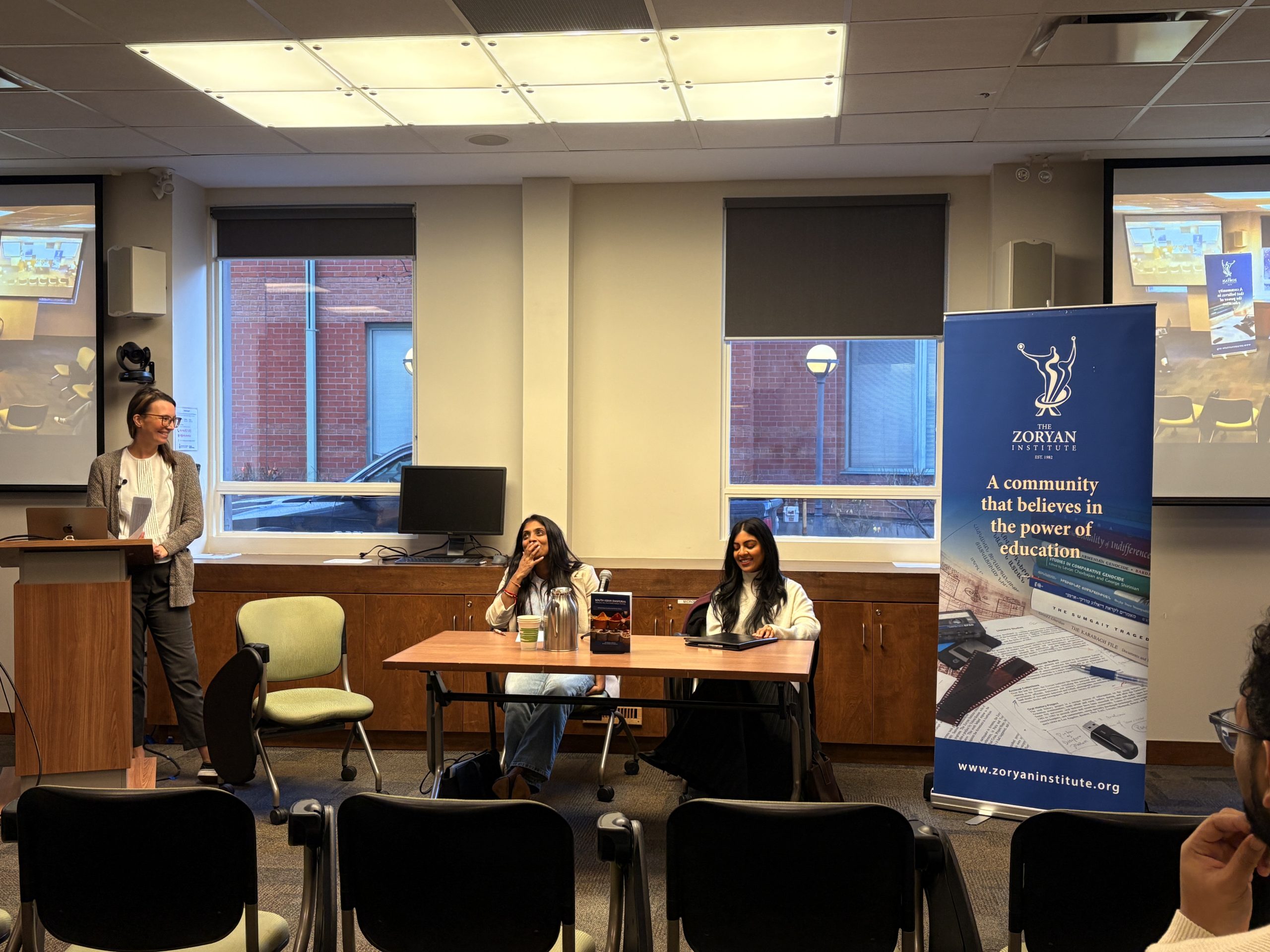
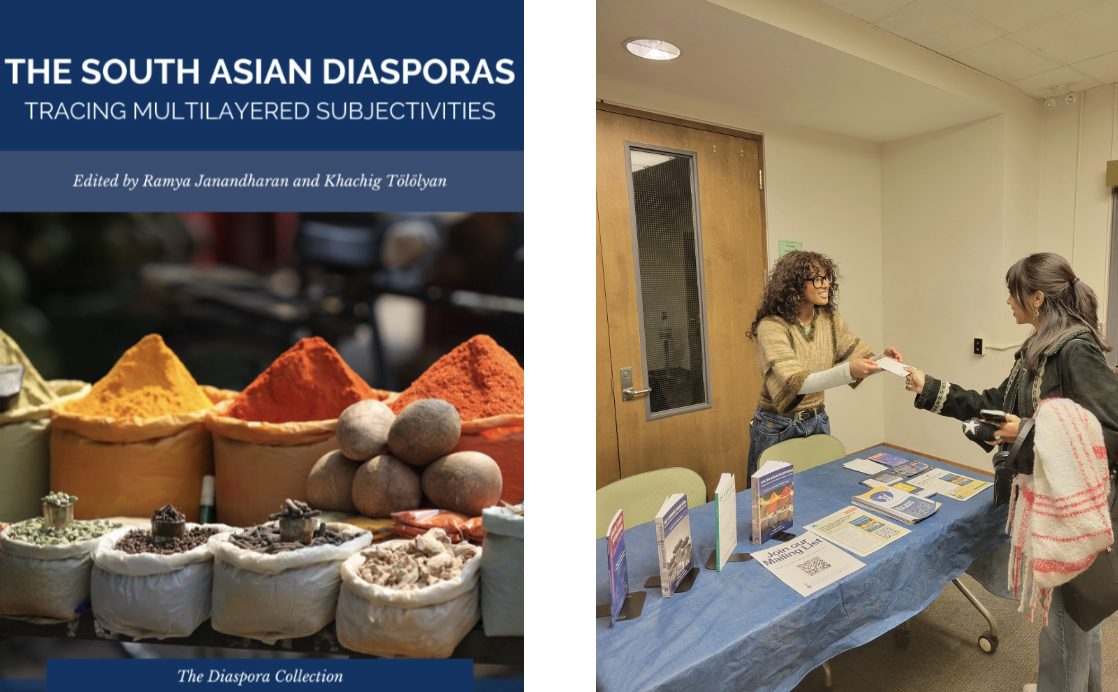
Toronto, ON, December 5, 2025 — On November 27, 2025, the Zoryan Institute, in collaboration with the Centre for Diaspora and Transnational Studies (CDTS) at the University of Toronto, hosted a book talk on its recent publication, South Asian Diasporas: Tracing Multilayered Subjectivities. Featuring co-editor Dr. Ramya Janandharan and contributing author Dr. Anuppiriya Sriskandarajah, the event brought forward a timely conversation on the shifting realities of South Asian identity in Canada and beyond.
As the newest volume in the Institute’s Diaspora Collection, a series that offers a critical research-driven window into the world’s largest diasporic communities, this book explores evolving South Asian identities. It provides valuable context for Canadians seeking to understand the country’s increasingly diverse social fabric to foster deeper, more informed communities across Canada.
Following brief opening remarks from Deputy Executive Director of the Zoryan Institute, Megan Reid, the speakers guided the audience through an overview of the book, personal reflections from its chapters, and an extended moderated dialogue before concluding with a lively Q&A.
Expanding on the book’s foundations, the discussion emphasized that even the term “South Asia” is historically fluid and politically constructed. Its boundaries encompassing what are now India, Pakistan, Bangladesh, Nepal, Sri Lanka and more, were shaped through colonial regimes that determined which populations and territories were included, excluded, or privileged. These same colonial structures set the foundations for contemporary migration flows and continue to shape diasporic experiences today.
Dr. Janandharan highlighted how the current rising anti-South Asian sentiment has taken root here in Canada. As described in her book’s introduction, she explained,
“In Canada, the boogeyman of anti-immigrant sentiment has more and more been taking the shape of the South Asian immigrant … This expresses deep fears about South Asian immigration and denies the ability of the South Asian diaspora to belong in or reflect the nation of Canada.”
Building on this, Dr. Sriskandarajah described how young South Asians today navigate these tensions in an era marked by intensified xenophobia. She argued that while Canada’s multiculturalism is often celebrated, it functions
“most effectively as a bonus the state provides for us to function within. However, in moments of crisis, multiculturalism is not on the table in terms of conversation. In this way, multiculturalism becomes less of a policy priority.”
Nevertheless, it continues to provide a framework for integrating the nation’s diverse cultural, religious, and racial makeup into a singular Canadian identity.
The South Asian Diasporas: Tracing Multilayered Subjectivities is now in print and available for purchase at $35.00 CAD. With the holiday season fast approaching, it makes a meaningful gift for anyone interested in migration and identity studies or South Asian diasporic experiences.
For interest in purchasing, please visit: https://zoryaninstitute.org/books/south-asian-diasporas-tracing-multilayered-subjectivities/
______________________________________
More About the Book:
South Asian Diasporas: Tracing Multilayered Subjectivities
The South Asian diaspora continues to evolve. So too do the forms of identity and community, some of which build off each other, and others that contest, challenge, and interact in unexpected ways. This volume seeks to understand the contours of the field of South Asian diaspora studies, bringing together a collection of articles by diverse authors. In finding connections between the different approaches, this volume will help to frame a more detailed picture of the dynamics of the South Asian diaspora and hint to the future trajectories this field may take.